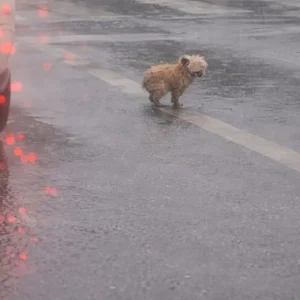
The lure of the open countryside is often irresistible to a curious dog. For a little terrier named Krakka, the vast fields near her home in the United Kingdom were an invitation to an adventure that quickly spiraled out of control. When she and her sibling escaped their house one afternoon, their owner, Glynis Elgey, was left waiting in dread.
A sliver of comfort arrived that same night when Krakka’s sibling returned home alone, but the relief was overshadowed by the growing absence of the small terrier. As the hours passed with no sign of her, the fear of what could happen in the sprawling farmland prompted the arrival of Steve Priestman and his team from Drone SAR for Lost Dogs UK.
By the late afternoon of the following day, the aerial search had yielded nothing, and the team was on the verge of calling it off. It was at that exact moment of uncertainty when Krakka’s sibling, who had been brought along to help, stopped scanning the open fields and became intensely fixated on a cluster of dark, narrow rabbit holes—pointing everyone to a reality buried right beneath their feet.
VIDEO: A Loyal Sibling’s Instinct Leads Rescuers to a Trapped Terrier
A Complication Tangled in the Soil
The drones had been scanning the horizon, but Krakka was trapped nearly three feet underground. Realizing the urgency of the situation, the rescue team immediately abandoned their screens, fell to their knees, and began to dig through the heavy dirt.
They had to move as carefully as they did quickly, unsure of how stable the earth was around the frightened terrier.
“A sudden discovery often brings a rush of relief, but the reality of a physical rescue is rarely that simple.”
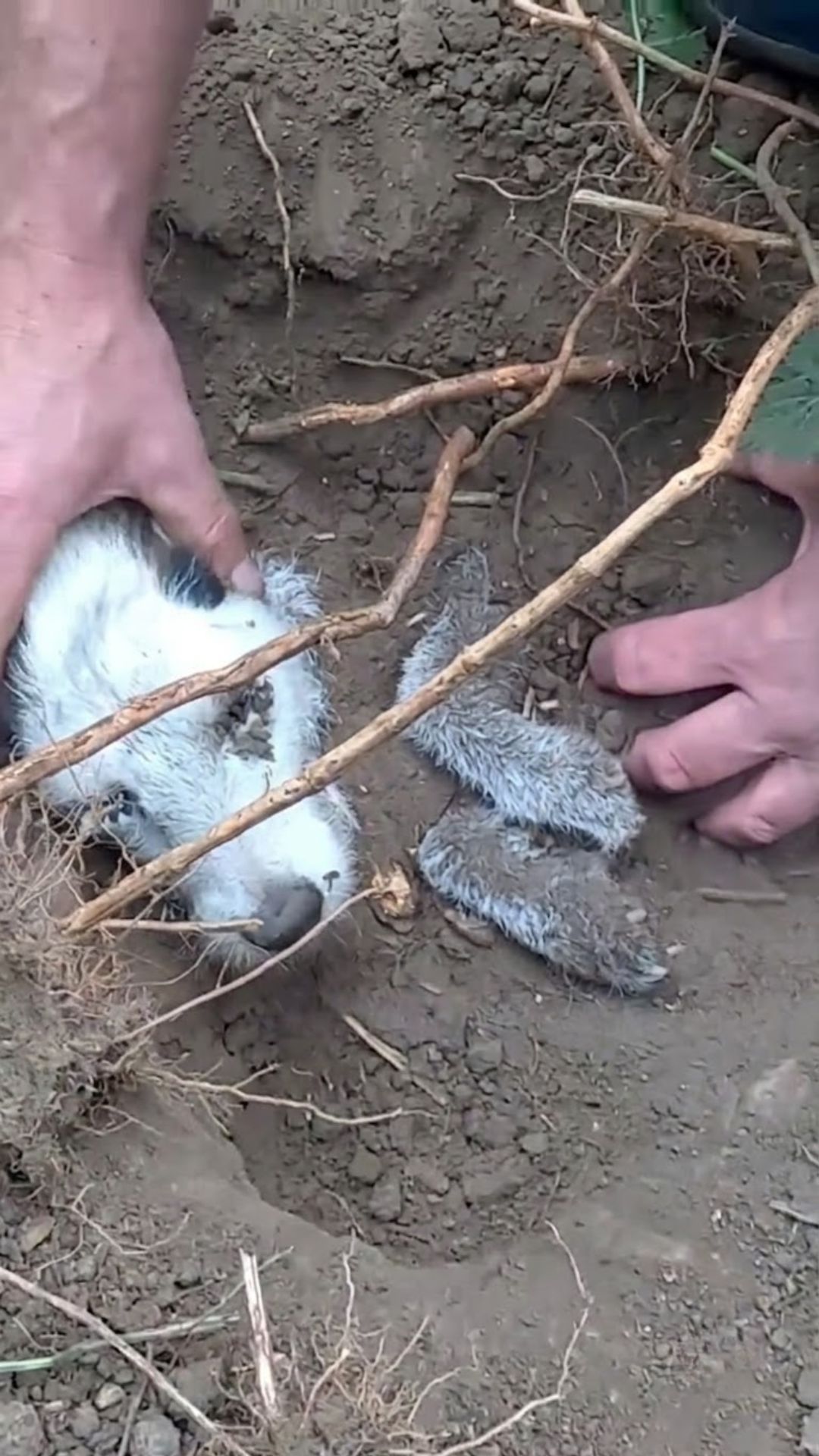
After widening the opening and clearing away layers of dirt, a tiny, fluffy white face finally emerged from the darkness. Steve and his team initially hoped they could just reach in, take hold of Krakka, and lift her back to the surface.
However, the earth had a much tighter grip on the little dog than anyone anticipated.
As they tried to free Krakka, they discovered that the extraction would be far more demanding than simply pulling her from a burrow. The problem wasn’t just the depth of the rabbit hole, but what lay hidden in the walls of the dirt.

Beneath the ground, thick tree roots had snaked their way through the soil, and one had wrapped itself tightly around the terrier’s abdomen.
She wasn’t just stuck; she was anchored in place, unable to push forward or pull back.
The Slow Release From the Dark
For twenty agonizing minutes, the rescuers set aside their digging tools and relied entirely on their bare hands.
“At first, I thought we’d be able to pull her out right away, but we quickly realized the situation was far more serious,” Steve recalled.
They gently scooped the soil away from Krakka’s fragile body, mindful of her distress in the confined, suffocating space. The team had to maneuver around the heavy root, carefully untangling the natural snare without causing her any pain.
It required patience and a highly delicate touch, a stark contrast to the frantic energy of the initial search above ground.

Once the root was finally cleared, the tension that had built up around the hole instantly broke. Krakka wiggled out from the tight space, leaving the cold confinement behind her.
There was no hesitation or lingering fear in her reaction. The moment she was free, the exhausted terrier leaped toward her rescuers, showering them with eager kisses and seeking comfort in their arms.
“We were all so relieved,” Steve shared. “It was an incredible feeling knowing she was going to be OK and reunited with her family.”

A thorough check by a veterinarian later confirmed that, despite her harrowing ordeal beneath the surface, Krakka had sustained no major injuries. She had survived the confinement and the cold, guided back to the light not by advanced aerial technology, but by the quiet, stubborn persistence of the sibling who refused to walk away.
“Sometimes, the strongest tether bringing a lost animal home is simply the bond of the one who stays behind to point the way.”