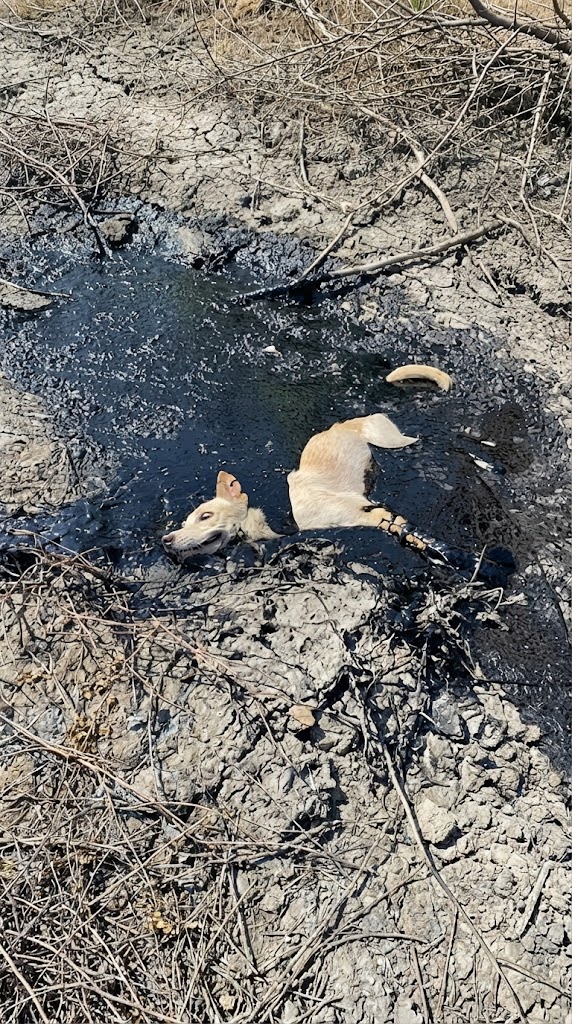
Along the dusty edge of an industrial estate in Nakhon Nayok, Thailand, a light brown stray dog named Mali was following her familiar afternoon route past a row of towering silos. Unaware of the hazard sitting beside the road, she stepped onto a dark patch of earth that appeared completely solid, only to feel the surface give way beneath her weight.
The ground was actually a deep pit of improperly discarded rubberized asphalt left out under the afternoon sun. Every movement Mali made to pull herself free only drew her deeper into the heavy, sticky mass, which quickly began to cool and tighten around her body until nothing but her small snout and terrified eyes remained above the surface.
Thirty-year-old Supatra Baisri was walking near the quiet factory grounds when a faint, muffled whimper caught his attention and drew him to the edge of the pit. Realizing immediately that stepping onto the deceptive surface to reach her would trap him in the deep tar as well, he dialed local emergency services and stayed by the edge, hoping a rescue crew could reach the struggling dog before she sank any further.
VIDEO: Watch the Careful Operation to Lift Mali From the Hardening Asphalt
A Heavy Machine for a Fragile Life
Waiting beside the pit was an agonizing test of patience for Supatra, who could see how hard the dog was working just to draw a breath. With the thick road waste clinging to her chest, there was no safe way to reach in by hand.
“I felt entirely helpless watching her sink, knowing that if I stepped in to pull her out, the toxic ground would claim me as well,” Supatra shared.
When the local emergency response team arrived on the scene, they immediately saw how little time Mali had left. As the afternoon heat faded, the industrial rubber was beginning to set around her ribs, pressing against her exhausted lungs like a tightening vise.
Because no rescuer could walk onto the tar, the crew had to bring in a heavy-duty excavator to reach her.
Using a massive piece of construction machinery to save a small dog required complete steadiness from the operator. One misjudged movement of the metal bucket could easily injure her, yet moving too slowly meant the asphalt would continue to harden around her frame.
Working with slow, measured precision, the operator maneuvered the excavator arm over the pit and carefully scooped beneath the heavy clumps of waste surrounding Mali without touching her body.
When the bucket finally lifted her clear of the trap and set her onto solid ground, she was barely recognizable. Half of her small frame was locked inside a dark, cooling shell of rubberized asphalt that pulled painfully at her skin every time she tried to shift her weight.

Factory Workers and Two Hours of Careful Work
Getting Mali out of the pit had saved her from suffocating, but the hardened mass encasing her body presented a second urgent problem. If the industrial mixture was allowed to cure completely against her coat, removing it without causing severe harm to her skin would become nearly impossible.
Seeing the rescuers working over the immobilized dog, several employees from a nearby factory hurried over to help, carrying large cans of benzine oil.
Together, the factory workers and responders knelt around Mali and began the slow, delicate task of dissolving the heavy crust by hand.
For two straight hours, they continuously poured small amounts of the oil over her hardened fur, working layer by layer to soften the stubborn rubber binding her legs and torso. Throughout the long process, Mali trembled violently from the stress and physical strain of the ordeal.
Yet as the heavy layers gradually melted away and the tight pressure around her body eased, her reaction began to shift.
Sensing that the people gathered around her were easing her discomfort rather than causing harm, the frightened shaking slowly gave way to deep exhaustion. She lay quietly against the ground, letting the strangers work until her limbs were finally able to move again.
Washing Away the Last of the Tar
Once the thick outer shell of asphalt had been dissolved, Mali was carried into a transport vehicle and rushed to a local veterinary clinic for medical evaluation. Although she could finally breathe and move freely, her coat was still coated in chemical residue and her skin underneath was heavily irritated from the ordeal.
The veterinary staff immediately gave her a gentle, medicated scrub, washing away the last traces of tar and oil until her light brown fur was clean again.
Even after hours of being trapped in the ground and handled by a crowd of strangers, Mali showed no defensiveness toward the clinic staff. Her calm, trusting demeanor remained intact as the team dried her off and settled her into a quiet recovery space.
Wrapped in clean, warm blankets with a bowl of fresh food placed within easy reach, the exhausted dog was finally able to let her guard down and rest in safety. Watching her drift off to sleep after everything she had endured that afternoon left a lasting impression on the veterinary team caring for her.

“True progress isn’t just about building the world around us, but ensuring we never leave behind careless traps that cost an innocent soul its future.”