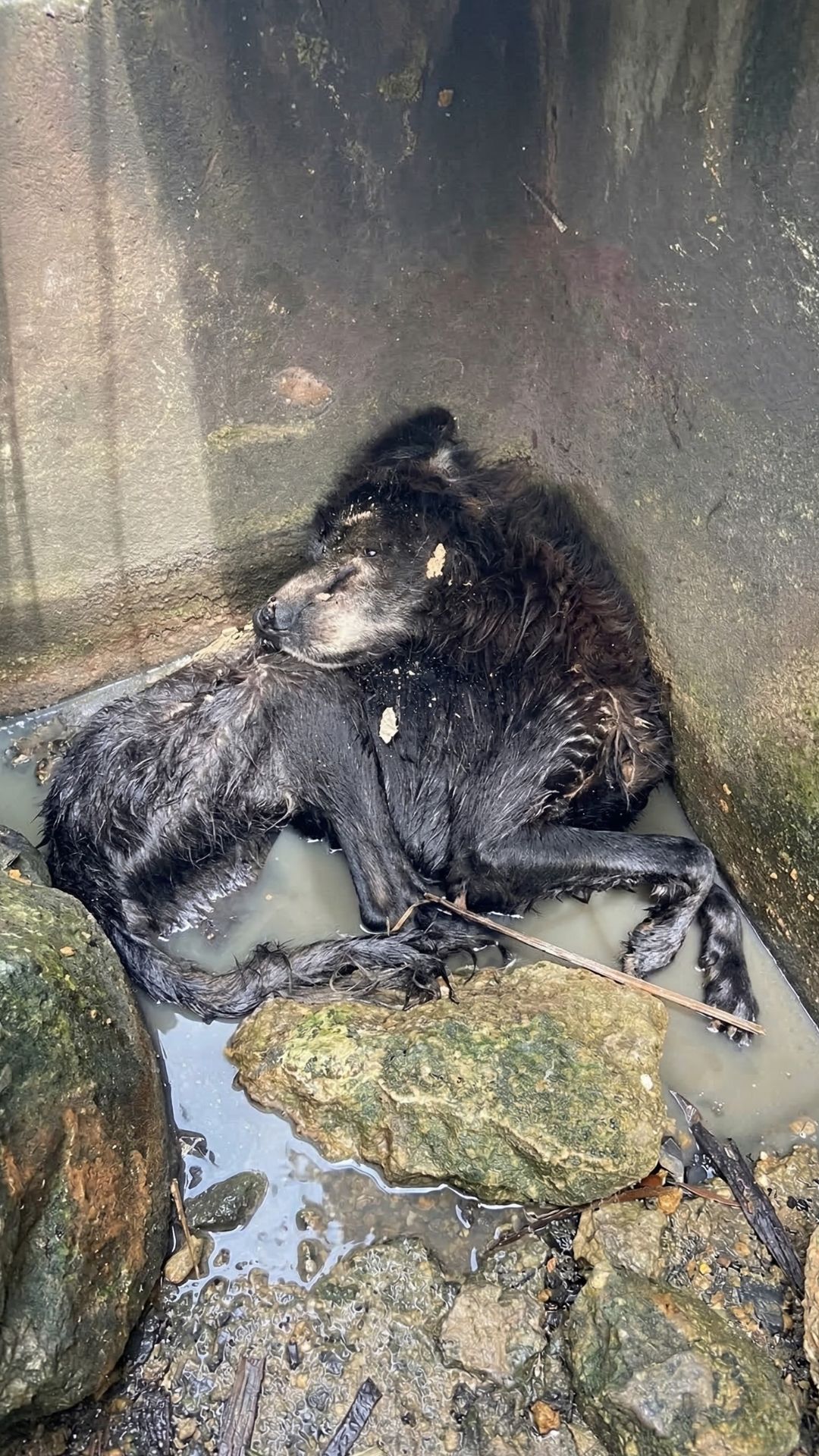
A young boy’s tears were the only reason anyone looked down into the damp, shadowed space of the sewer. Next to a deserted stretch of road, a dog lay soaking wet against the cold concrete. It was immediately clear that this was no accident. Thick, twisted ropes were tightly bound around his body, deliberately anchoring him to a place where he was never meant to be found.
The dog, later named Bruno, was entirely stripped of his mobility. When a rescuer carefully reached down and attempted to turn him to loosen the bindings, a sharp scream echoed out of the drain. The pain was too immense to risk further movement. He lay there shivering, his body unable to respond to his instinct to flee, completely paralyzed by the heavy trauma he had endured.

A shallow dish of water offered the first moment of relief. Bruno drank eagerly, but the brief surge of energy only made him try to scramble away—an effort immediately halted by both the heavy ropes and his failing limbs. As the rescue team waited anxiously for transport, fearing the drain might suddenly flush with water, they kept a quiet watch over the broken dog, wondering just how deep his injuries truly went.
VIDEO: Tangled in the Shadows of a Roadside Drain
The Mark of a Heavy Impact
Once pulled from the drain and rushed to the clinic, the full scope of Bruno’s condition began to surface. Beneath his thick, wet fur lay a heavy infestation of ticks, a quiet sign of prolonged neglect that had started long before he ended up in the sewer.
But the real danger was entirely internal.
Veterinary exams revealed severe dehydration and a traumatic brain injury, the result of a devastating blow from a blunt object. The neurological damage explained his complete lack of physical control. Fortunately, he would not require invasive surgery, but the path forward would demand strict medication, continuous fluids, and an extraordinary amount of time.
“Physical wounds can be stitched and closed, but a damaged nervous system requires the quietest and most agonizing kind of patience.”

The Will in a Bowl of Food
Despite the heavy fog of his head injury, Bruno possessed an undeniable anchor to the waking world: his appetite.
He devoured every meal placed in front of him, eating with an urgency that suggested he had never known a full stomach before.
This simple act of eating became his earliest physical therapy. As he consumed his food, his trembling legs would begin to shift. He desperately tried to push himself upright just to reach his bowl, battling the profound disconnect between his brain and his muscles day after day.
Five Months to Find His Footing
The timeline of healing stretched far beyond initial expectations.
It took three full months of careful support and medication before Bruno could finally manage to stand on his own four feet. Even then, his balance was incredibly fragile. The trauma to his brain made every movement a massive calculation.

Yet, the heavy, pained expression he wore in the sewer had entirely vanished, replaced by a bright, relaxed smile that grew wider with every small victory.
It was not until the five-month mark that Bruno finally achieved a steady, normal walk.
“Sometimes, the greatest measure of resilience isn’t found in a sudden recovery, but in the willingness to try taking the same impossible step for a hundred days in a row.”
He had significantly filled out, his frame no longer reflecting the starved, broken creature pulled from the cold drain.

With his mobility fully restored, Bruno’s world expanded far beyond the clinic walls. His arduous journey culminated in a simple shopping trip to pick out supplies for his permanent home. Watching him happily browse the aisles, completely free of the ropes that once bound him, offered a profound sense of closure.
A life deliberately cast into the shadows had finally stepped out into the light, ready to experience the quiet dignity of simply being a dog.