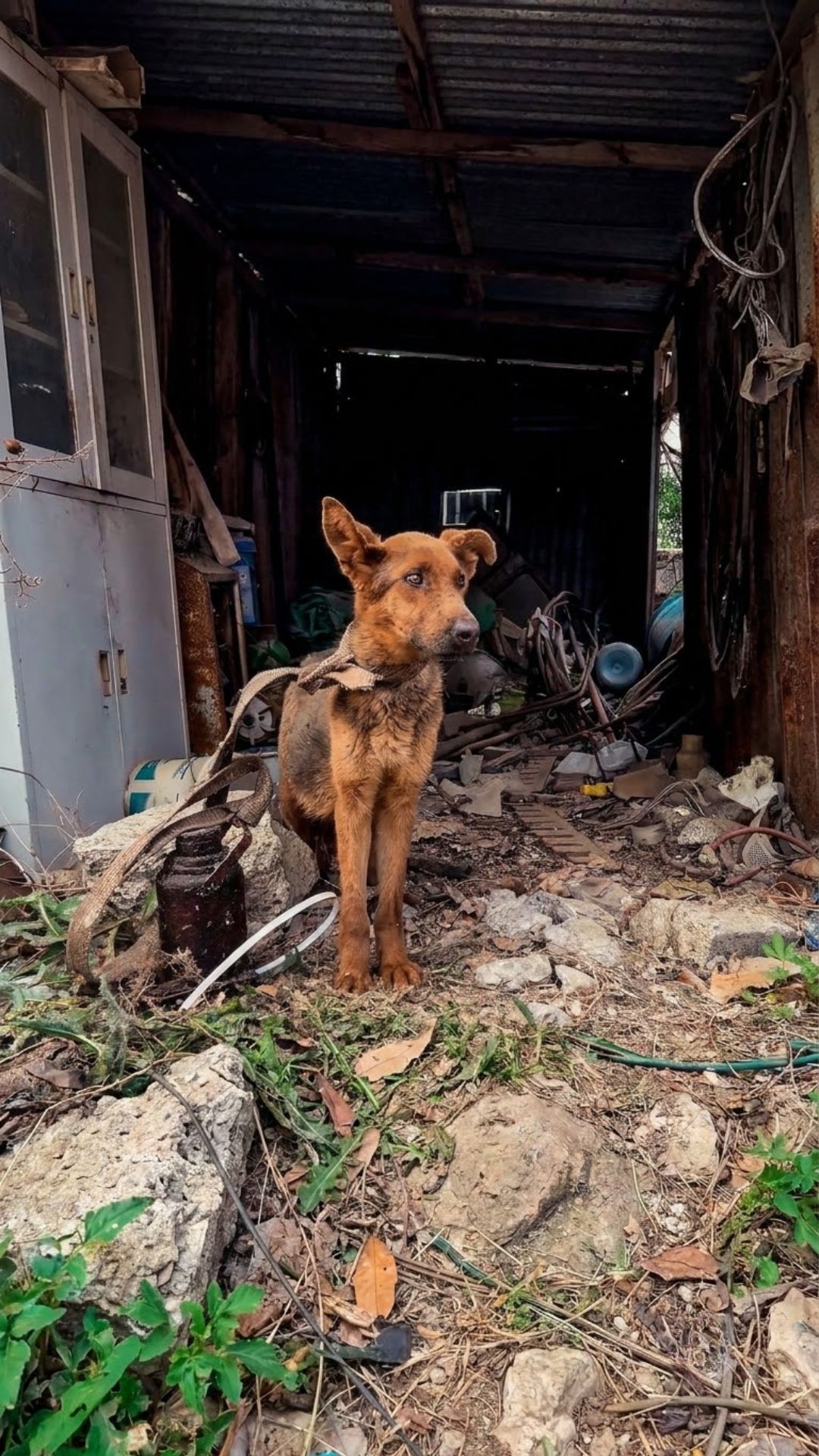
When a dog falls seriously ill, the cost of a cure can sometimes break the bond between an animal and its owner. For one dog, a severe medical condition meant being left in a derelict building. His owner, overwhelmed by exorbitant veterinary bills, had made the difficult decision to surrender him, hoping someone else could carry the weight of his failing health. By the time rescuers arrived to take the leash, the dog’s abdomen was severely distended, heavy with fluid and taut like a water balloon.
The physical toll of his illness was evident, but the emotional exhaustion was even clearer. The moment he was picked up and carried to a vehicle, the dog began shivering uncontrollably. A deep unease settled in his eyes, and a low, faint whimper escaped his throat. He had been given away, his body was failing, and he had no way of knowing where he was being taken.

At the veterinary clinic, the dog’s fear kept his body rigid. As the doctor gently reached out to examine the swollen belly, the dog shifted backward, his limbs tensing to support his fragile weight. The touch had to be uncomfortable, perhaps even painful. Yet, as the seconds passed, he didn’t struggle or pull away. He simply stood there, trembling but compliant, waiting to see what these strangers would do next.
VIDEO: A Surrendered Dog Begins a 38-Day Journey to Healing
The Hidden Invaders
Blood tests and a biopsy soon revealed the root of the extreme abdominal swelling, a condition known as ascites. Under a microscope, the veterinarian identified a severe parasitic infection.
Roundworms were thriving in his intestines, while flukes had invaded his liver. These parasites were voraciously depleting the dog’s nutrients, leading to long-term malnutrition and severe internal damage. Because his liver was compromised, his albumin levels had dropped dangerously low, causing fluid from his blood vessels to leak directly into his abdominal cavity.
He was slowly starving, even as his body grew heavier.
To save him, the veterinary team had to move carefully. They couldn’t simply drain the fluid all at once, as the sudden loss of protein would shock his frail system. The treatment would require precise deworming, liver-protecting medications, and slow, calculated fluid drainage.

Despite the invasive tests and the strange environment, the dog’s demeanor began to shift. Hearing the soft, encouraging voices of the clinic staff and his rescuers, the tension in his face finally broke.
“Sometimes, the smallest sign of trust is the moment that tells you how far an animal has already come.”
The corners of his mouth turned up in a soft, gentle smile. It was a brief flash of warmth from a dog who had every reason to shut down completely.
The Weight of a Cure
While the dog’s spirit was willing, his physical recovery was agonizingly slow. After a drainage tube was successfully placed, the anesthesia wore off at a crawl.
He was incredibly frail.
To rebuild his strength, the rescue team prepared fresh chicken and soft mats, patiently coaxing him to eat meals laced with bitter medications. But treating chronic ascites required more than just good food and basic medicine; it required constant infusions of albumin to help regulate the fluid balance inside and outside his blood vessels.
The cost was staggering.
Pet-specific albumin was priced at $100 per infusion, a massive financial burden for a small rescue. The medical bills piled up, hanging like a heavy stone over the team. Determined not to give up, the rescuers took on part-time jobs—spending hours cutting garlic for local vendors—just to keep up with the mounting debt. Following the vet’s advice, they carefully switched to strictly regulated human albumin, which offered similar efficacy at a more manageable cost.
Through it all, they watched the dog. They watched his eyes grow brighter and his appetite return. To mark this turning point, they gave him a new name: Fuwa, a word symbolizing good fortune and a treasured life.

Thirty-Eight Days of Waiting
Treating chronic ascites is not a linear process. It requires immense patience and the willingness to endure setbacks.
For over a month, Fuwa’s rescuers practically lived between their shelter—affectionately called the “small courtyard”—and the veterinary hospital. They ignored the whispers of critics who dismissed their efforts as a publicity stunt. They knew the truth was in the quiet moments: the way Fuwa gently rubbed his head against their hands when they arrived, and the way the volume of fluid drained from his abdomen slowly decreased day by day.
Finally, on the 38th day, the doctor delivered the news they had been waiting for.
The inflammation was under control, his liver function was improving, and the ascites had reduced to a minimal level.
Fuwa was ready to be discharged.
A Room of His Own
Leaving the hospital didn’t mean the end of Fuwa’s medical care. He would still need liver medications, bile acids, and a highly nutritious diet to consolidate his recovery. But he would finally do it outside the confines of a clinical cage.

Back at the small courtyard, the team had prepared a separate, quiet room just for him. Thoroughly cleaned and disinfected, it was a safe space away from the energetic chaos of the other rescued dogs.
When Fuwa first stepped into his new room, he was hesitant. He paced gently, sniffing the corners with a mix of curiosity and lingering nerves. But as his rescuers spoke softly and stroked his head, the familiar comfort settled in.
“A home is not defined by luxury, but by the certainty that you will never be left behind again.”
Just a week after his discharge, Fuwa was already taking regular walks outdoors. The heavy, painful belly that once weighed him down was gone. In its place was a stronger, more vibrant dog, eager to explore the world with a wagging tail and the same warm smile that had given his rescuers hope on his very first day.