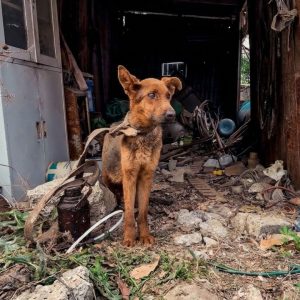
When Boston police officers stepped inside a Roxbury apartment on the Fourth of July, they were met with a sight that even seasoned responders struggle to comprehend. Locked inside a bedroom cage with an electric collar around his neck was a three-year-old brown Pit Bull-mix named Jobee, living without adequate food or water in conditions of extreme neglect.
Shortly after officers left the residence, someone removed the fragile dog from the home and abandoned him near a neighborhood dumpster. By the time he was recovered and rushed to the MSPCA’s Angell Animal Medical Center, Jobee weighed just 24-and-a-half pounds—roughly half of what a healthy dog of his size should carry.
Depleted to the point where his body was beginning to fail him, Jobee stumbled as he came through the clinic doors, unable to fully stand or walk on his own. Yet as the medical team gathered around the trembling dog who was only days away from death, they noticed something remarkable in his demeanor—though whether his exhausted body could actually survive the days ahead remained uncertain.
VIDEO: Rescuers Rush a 24-Pound Dog From a Roxbury Dumpster to Emergency Care and Witness His Quiet Fight to Survive
A Body Pushed to the Edge of Survival
Inside the emergency room at Angell Animal Medical Center, veterinarians quickly realized they were looking at a level of prolonged deprivation none of them had ever encountered before.
For Mike Keiley, the MSPCA-Angell Director of Adoption Centers and Programs, Jobee’s arrival stood out across nearly three decades of animal welfare work.
“I’ve been working at the MSPCA for 29 years and have seen many law enforcement cases of negligence but I honestly can’t say I’ve seen a skinnier dog that’s still alive until we met Jobee,” Keiley said. “It’s pretty tragic. He couldn’t even really fully walk or stand on his own when he came in.”
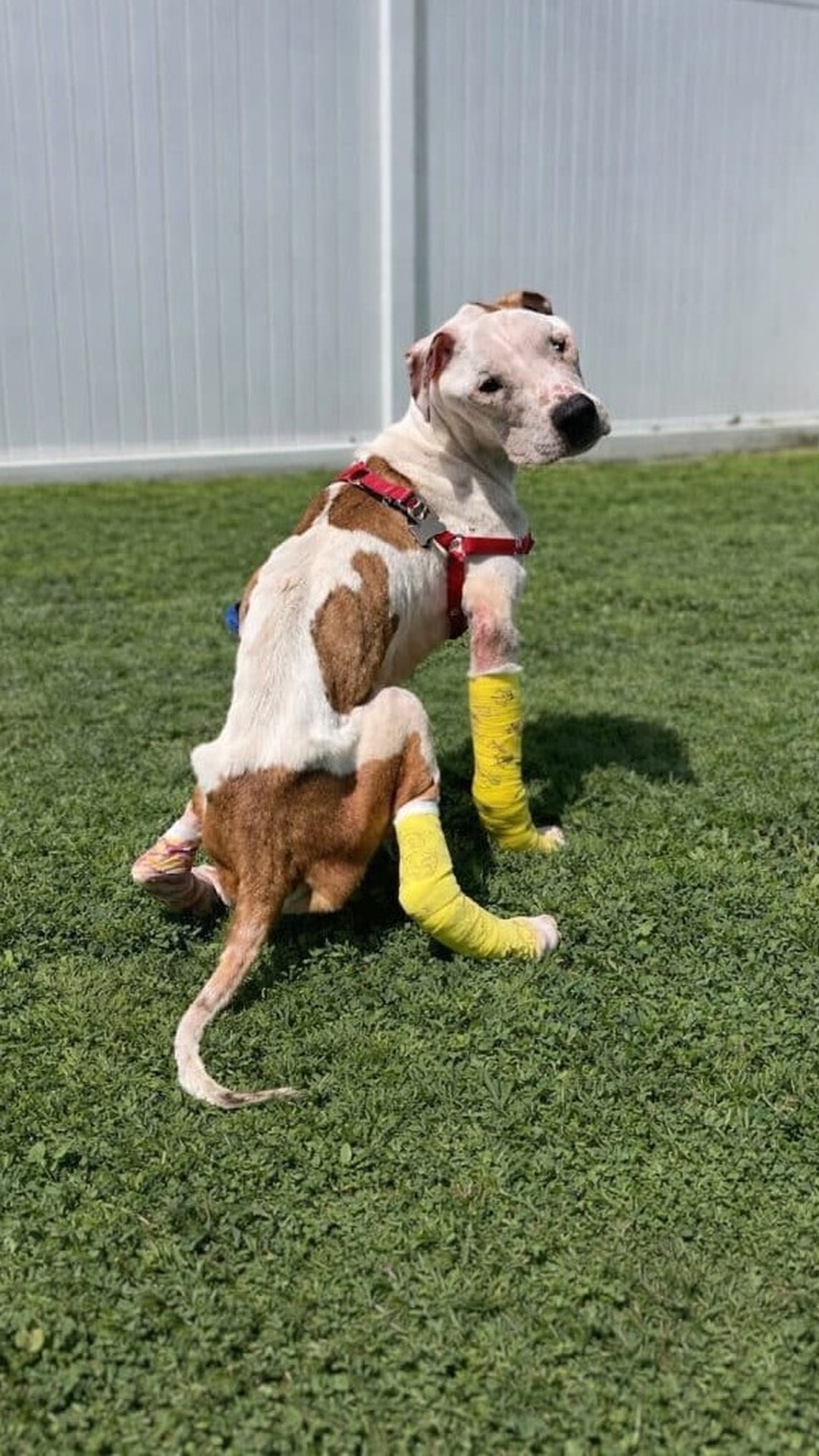
The physical toll of his past went far beyond weight loss. Because Jobee had reached such an advanced stage of starvation, his body had begun losing circulation to his extremities, leaving him with painful open wounds and severe tissue damage that ultimately required part of his tail to be amputated.
Even more concerning to the medical staff was what was happening on the inside.
“This is the worst case of starvation I’ve ever seen in a dog and I’m stunned that he survived,” said Dr. Kiko Bracker of Angell’s Emergency & Critical Care Service. “He had no food in his stomach or digestive tract, which had all but shut down. And we needed to be very, very careful in nursing him back to health.”
When an animal’s digestive system has been empty for that long, even the simple act of feeding carries serious medical risks. The team could not simply offer him a full bowl of food; instead, they had to place him on intravenous fluids and begin a slow, delicate process of waking his body back up.
“Sometimes the hardest part of saving a life is having the patience to heal slowly when every instinct wants to give them everything they were denied at once.”
The Quiet Spark That Kept Him Going
In many cases of severe neglect, the emotional damage is just as difficult to overcome as the physical frailty. Dogs who have spent months locked away without comfort or nourishment often withdraw completely by the time help arrives.
Jobee, however, responded to his caregivers in a way no one took for granted.
“We’ve seen in previous cases that dogs this neglected essentially give up and do not recover—but it was clear from the first minute in our care that Jobee wanted to live,” Keiley shared. “[Jobee] inspired us all and captured every heart along the way.”

Day after day, the veterinary staff monitored his vitals and adjusted his care in small, careful steps. Slowly, the intravenous fluids did their work, and his weakened system began to respond to the gentle routine of the hospital.
Within two weeks of his admission, Jobee reached a milestone that once seemed out of reach: his digestive tract was strong enough to accept solid food again.
By July 19, the dog who had arrived stumbling and barely clinging to life was stable enough to be discharged from Angell Animal Medical Center. From the hospital, he was transferred directly into the care of the MSPCA’s Boston Adoption Center to continue rebuilding his strength.
A second dog named Remy, who had also been found inside the Roxbury home in a less severe state of malnutrition on the Fourth of July, was safely placed into a foster home.

Accountability and a Different Future Ahead
While Jobee was learning to trust the steady hands of his caretakers, authorities worked to ensure accountability for what he had endured. Months after the initial July visit—and after placing 36-year-old Lakeida Burris on the Boston Police Department’s “Most Wanted” list—officers arrested her in the area of Ernst Street on two counts of animal cruelty.
In court, a defense attorney argued that Burris had not been home at the time and claimed the dog belonged to someone else.
“When she found out there was a dog in the house, she told them ‘That dog should not be in the house,’” the attorney stated.
However, the case carried a troubled history, as Burris had previously faced an animal cruelty charge in May 2022 when another dog in her care had to be euthanized due to neglect. Ahead of her September court date, she was ordered held in custody and barred from having any animals in her home.
Away from the courtroom, inside the quiet halls of the Boston Adoption Center, Jobee’s daily life now looks nothing like the cramped bedroom cage or the alley beside the dumpster where he was left behind.
With regular meals, soft bedding, and gentle medical attention, the hollow frame that once shocked veteran rescuers has steadily begun to fill out. More importantly, staff members who watched him struggle just to stand on his own now see bright sparks of life in his eyes as he prepares for the day he will be ready for adoption.
“A body can be starved down to half of what it should be, yet the spirit inside it can still remain entirely whole.”